
Best Enterprise AI Research Platforms in 2026
Posted 10/21/2026
4 min read


Best Enterprise AI Research Platforms in 2026
87% of institutional firms have now deployed AI or embedded it in a business process. That figure comes from BlackRock's Aladdin AI Adoption Report 2026, fielded between May and July this year across 303 senior decision-makers at asset managers, insurers, pension funds, banks, and wealth managers.
The same survey found that most of those firms still cannot produce a consistent, trusted view of their total portfolio. 72% rely on eight or more platforms to run fund lifecycles and investment operations. 56% name dependence on legacy technology as their single biggest operating model problem.
Read those findings together and the procurement question changes shape. Adoption is no longer the hard part. Integration is. Which means the real risk in choosing an AI research platform is not that it underperforms in a demo. It is that it becomes the ninth system, adding another login, another identifier scheme, and another place where something material gets missed.
This comparison evaluates six platforms through that lens.
Quick guide: six AI research platforms for financial institutions
Orbit Insight. Built the document corpus and the reasoning layer together, with citations to the source page on every claim, published pricing, and an open API and MCP server so the platform reduces your system count rather than adding to it.
AlphaSense. The largest pure play in the category, with a document library exceeding 500 million and the expert call inventory acquired with Tegus. Quote-only pricing and per-seat economics.
Hebbia. The strongest reasoning interface for running one analytical question across thousands of documents at once, without its own proprietary data corpus.
FactSet Intelligence. The incumbent moving fastest on agents, though its banking product launched in alpha in March 2026 and the buy-side workflows trail the banking ones.
Rogo. Purpose-built for investment banking deal work, now at a $2 billion valuation, with third-party data rather than a corpus it owns.
S&P Capital IQ Pro. Depth in credit, private markets, and structured fundamentals, with AI capabilities newer than the data underneath them.
How we evaluated them
We assessed each platform the way a Head of Research assesses a multi-year commitment, rather than the way a demo assesses a feature list.
Does it reduce your system count or increase it? Given that most institutional firms already run eight or more platforms, a research tool that cannot connect to the rest of the stack is adding to the problem it claims to solve.
Can every output be traced to a primary document? If a portfolio manager cannot verify a claim in front of the investment committee, the platform has failed the only test that matters. This is also where the regulatory exposure sits.
How much of the coverage universe does it actually reach? Specifically outside North America and Western Europe, where most coverage claims quietly stop.
Does it own the data or rent it? A reasoning layer over documents you supply is a different purchase from a platform that maintains the corpus. Both are legitimate. Confusing them is expensive.
Who controls the model choice? When the research workflow depends on one provider's model roadmap and pricing, switching costs compound every quarter.
What does scaling cost? Per seat licensing ties research capacity to headcount, which means coverage expands only when procurement approves it.
The six platforms
1. Orbit Insight
Orbit is an award-winning AI investment research platform built for institutional buy-side teams, and its distinguishing architectural decision is to build the document infrastructure and reasoning layer together rather than add AI to an existing feed or data to an existing interface.
The Knowledge Base processes 70 million documents a year across more than 75,000 companies and over 80 exchanges, spanning 308 document types parsed at better than 99 percent accuracy, with tables extracted, sections tagged, and every document resolved to a single entity master. That entity master directly addresses the eight-platform problem, because reconciling the same issuer across EDGAR, an exchange feed, a transcript provider, and the internal book is the work fragmentation creates.
Filings, transcripts, regulatory publications, sustainability disclosure, news, broker research, and a firm's own internal research sit in one queryable layer. Every answer traces to the specific filing and page it came from.
What it does well
The Research Agent answers questions in plain language across the full corpus and shows its sources, so verification is one click rather than an email to the vendor.
Orbit Agent Builder lets analysts encode their own methodology into agents with no code and no engineering support, running them on a schedule or triggering them on a new filing. The Agent Marketplace offers prebuilt agents that analysts can open and edit rather than accept as-is.
Coverage includes 5,500 China A-Share tickers with institutional on site research transcripts, where mainland listed companies disclose the questions asked by visiting brokers and asset managers. That content has no Western equivalent and is not available through the other platforms here.
Model routing is not tied to one provider, so quality improves as models advance without a migration.
Deployment runs in the cloud, private cloud, or on-premises, which is where security review usually stalls.
Pricing is published, starting at £75 a month and priced by credits consumed rather than by seats, with API and Orbit MCP access included at every tier. Among the platforms on this list, Orbit is the only one a team can evaluate without a procurement cycle.
Where it stops
Orbit does not provide real-time market data or execution, so it does not replace a terminal for a trading desk.
Private markets coverage is thinner than a dedicated provider at the moment.
The entity master and Knowledge Base reward firms that bring their own internal taxonomy to the onboarding conversation, which is a planning requirement rather than a technical one.
Best for: buy side research teams whose constraint is unstructured document coverage, firms with global or APAC mandates, quant and data teams that need programmatic access, and sustainability teams producing their own metrics from primary disclosure.
2. AlphaSense
AlphaSense is the largest pure play in this category and should be evaluated as the incumbent it has become. It raised $350 million in June 2026 at a $7.5 billion valuation, with roughly $600 million in annual recurring revenue across more than 7,000 enterprise customers.
What it does well
The content library exceeds 500 million documents, and the Tegus acquisition added an expert-call inventory with no direct equivalent elsewhere on this list. Generative Search reasons across qualitative and structured content in one interface. Enterprise Intelligence brings internal documents into the same searchable layer, and supports deployment into AWS and GCP.
Where it stops
Pricing is quote-only, with no published list and no self-serve tier. Reported enterprise seats cluster near $18,000 a year before content add ons that buyers commonly describe as another twenty to forty percent of contract value, and seats are sold in bands, so adding a handful of users can move a firm into a higher tier.
The architecture centers on search and discovery rather than persistent monitoring across a full coverage universe, so it wasn't built for standing surveillance of a book.
Model orchestration is not open, which matters for firms that want to route tasks across providers.
Coverage skews to English-language sources. Depth in China A-Shares and emerging market filings is materially thinner than the headline document count implies.
Best for: firms whose priority is search quality across Western filings, transcripts, and expert content, and that can absorb per seat pricing.
3. Hebbia
Hebbia built Matrix, an interface that runs one analytical question across hundreds or thousands of documents at once and returns an auditable grid rather than a paragraph. It has raised over $160 million from Andreessen Horowitz, Index Ventures, and Google Ventures.
What it does well
For diligence, data room review, and credit agreement work, the Matrix shape fits the task better than a chat interface does. The multi-agent approach handles decomposition well, and the output format makes verification straightforward.
Where it stops
Hebbia does not own a data corpus. It reasons over documents you supply or content licensed from others, which is why it has announced integrations with FactSet, Third Bridge, and Preqin. If you can't access the underlying documents in the first place, particularly outside the United States, a reasoning layer won't solve it, and you'll end up paying for the data separately.
For a firm already running eight platforms, adding a reasoning layer that requires its own data subscriptions doubles the count.
Best for: investment banking and private markets teams working primarily on documents they already hold.
4. FactSet Intelligence
FactSet has moved faster than any other incumbent on agents. It launched FactSet AI for Banking in alpha on March 30, 2026, built in collaboration with Finster AI alongside an investment in that company, and it shipped a production-grade MCP server in December 2025 covering nine datasets, extended to portfolio analytics in June 2026.
What it does well
The banking product generates pitch materials, company profiles, memos, and buyer and seller analysis from natural language prompts, with traceability and trigger based automation. Deployment supports virtual private cloud and single-tenant configurations for regulated firms. The architecture is explicitly open to clients bringing their own MCP servers and datasets, which is unusual for an incumbent and genuinely useful.
Estimates, consensus, and portfolio analytics remain strong, and the MCP work makes that data reachable from an agent without an integration project.
Where it stops
AI for Banking entered alpha with select clients in March 2026 with broader rollout planned across the year, so what a buyer can deploy today is narrower than the announcement suggests. Confirm availability before building a plan around it.
The agent workflows are most developed for banking and wealth. Buy side research automation receives less attention.
Pricing is negotiated per user in a band commonly running from around $12,000 into the tens of thousands, so seat economics persist.
The MCP exposes curated structured datasets rather than the underlying document corpus, so filing level research across risk factors or management commentary sits outside it. Partnering with Finster AI for the reasoning layer is a reasonable strategy and also tells you where the capability came from.
Best for: investment banks and wealth teams already licensed with FactSet.
5. Rogo
Rogo automates investment banking workflows, including comp analysis, meeting preparation, company profiles, and pitchbook creation. It raised $160 million in April 2026 at a $2 billion valuation, has served more than 300 institutions and 35,000 users, and names Jefferies, Lazard, Moelis, Rothschild, Nomura, Truist, and Baird among its clients.
What it does well
Direct integration into PowerPoint, Excel, and Word means it meets bankers where they work. Multi-cloud and on-premises deployment addresses restricted security environments, and role-based permissions and audit trails meet institutional governance requirements. Models are trained on professionally labeled financial data to reflect firm standards.
Where it stops
Rogo has no proprietary data moat. It integrates with Capital IQ, Preqin, PitchBook, Crunchbase, LSEG, and Dow Jones Newswires, which firms pay for as separate data subscriptions. The same constraint that applies to Hebbia applies here with a different interface.
The focus on banking deal workflows limits applicability to buy-side research, portfolio monitoring, and systematic processes.
Coverage concentrates on English-language markets and the content types common in United States and European banking.
Per-seat pricing ties revenue to headcount, which is a consideration for a buyer as much as for the vendor.
Best for: investment banking deal teams that want workflow automation inside Office.
6. S&P Capital IQ Pro
S&P Capital IQ Pro provides structured datasets spanning fundamentals, estimates, transactions, and credit, connected to S&P Global's wider ecosystem including ratings and benchmarks. Kensho exposes Capital IQ financials and transcripts through a hosted endpoint that AI assistants can query.
What it does well
Financial history, credit analytics, and private company coverage are difficult to match. The Kensho work makes that data reachable from agentic workflows, and the cross-asset footprint spanning public companies, private markets, credit, and commodities is genuinely broad.
Where it stops
The AI capabilities are newer than the underlying data, and agent and automation features are still maturing relative to the structured data offering.
Access through the S&P Global Marketplace adds a procurement approval step before evaluation can begin.
The platform is oriented toward structured data queries, with less depth processing unstructured documents such as transcripts and regulatory filings at scale.
The workstation model constrains teams building programmatic, API first research pipelines.
Best for: credit teams, private markets analysis, and corporate finance.
Also worth knowing
LSEG Workspace has pursued the widest distribution of any incumbent under its LSEG Everywhere program, shipping MCP connectivity through Databricks in November 2025, a ChatGPT connector in December 2025, and extensions to Amazon Quick and Gemini Enterprise in May 2026, alongside a Deep Research agent. The rollout is explicitly phased, so what is queryable today is narrower than the announcements imply, and access requires existing LSEG licensing. The AI capability is limited to LSEG-licensed content.
Bloomberg has deliberately taken the opposite path. It runs Enterprise MCP infrastructure internally, contributed to the protocol specification, holds seats on the Agentic AI Foundation, and launched ASKB inside the Terminal in January 2026. What it has not done is expose an external connector into Claude, ChatGPT, Gemini Enterprise, or Copilot Studio. Terminal data doesn't reach your AI workflows through an open protocol, and that is a decision, not a gap.
At a glance
Owns its document corpus. Orbit, AlphaSense, FactSet, and S&P Capital IQ each maintain one. Hebbia and Rogo do not, and integrate licensed data or documents you supply.
Citation to the source page on every claim. Orbit delivers this by default. AlphaSense returns sourced outputs. FactSet offers traceability within its banking product. Rogo and S&P Capital IQ provide partial attribution rather than page-level citation into primary documents.
Published pricing. Orbit publishes prices starting at £75 a month. Every other platform here is quote only.
Pricing model. Orbit charges by credits consumed. AlphaSense, FactSet, S&P Capital IQ, and Rogo charge per seat. Hebbia prices by enterprise agreement.
China A-Share depth. Orbit covers 5,500 tickers, including institutional on-site research transcripts. The others cover the region partially or through licensed third parties.
Model choice. Orbit routes across providers. Rogo runs on OpenAI and Anthropic models. The remainder do not expose model orchestration.
On-premises deployment. Orbit, Rogo, and FactSet support it. AlphaSense supports AWS and GCP under its enterprise tier. S&P Capital IQ and LSEG are effectively hosted.
Built for buy-side research. Orbit and AlphaSense. Hebbia, Rogo, and FactSet Intelligence are strongest in banking and deal work. S&P Capital IQ leads in credit and private markets.
The procurement question nobody asks in the demo
Every platform on this list demos well. They are all competent, several are excellent in their domain, and the differences that decide a five-year commitment are rarely visible in a 45-minute session.
Three questions separate research infrastructure from research tooling.
Does this reduce the number of systems, or add one? With 72 percent of institutional firms already running eight or more platforms, and 44 percent naming fragmented systems as a top operating model challenge, a platform that cannot index your internal research alongside external content and cannot reach your other tools programmatically is making the measured problem worse. Ask specifically whether internal documents can sit in the same queryable layer, and what the API and MCP surface actually exposes.
Does it pre-process documents, or re-read them on every query? This determines both cost and consistency at scale. A platform that parses, structures, and indexes in advance gives the same answer twice. One that re-reads raw text per query does not, and the bill grows with usage in ways that are hard to forecast.
How does it resolve entities across markets and languages? The same issuer carries a different identifier in every system it appears in, and without a master, subsidiaries, dual listings, and name changes reconcile to nothing. This is the least glamorous capability in any demo and the one that quietly determines whether coverage claims hold.
The spending makes the stakes concrete. KPMG's Q1 2026 AI Pulse Survey found asset management and private equity firms projecting an average of $148 million in AI investment over the next twelve months, up from $101 million the previous quarter. The same survey ranked difficulty scaling use cases as the top barrier to demonstrating return, at 85 percent, second only to skills gaps.
Scaling difficulty is usually an integration problem wearing a different name.
Why the data layer decides the outcome
Firms that move fastest invested in data infrastructure first and models second. That sequence matters because model performance is converging while infrastructure quality is not.
A reasoning layer can be replaced in a quarter. A corpus that monitors disclosure across dozens of jurisdictions, parses inconsistent formats reliably, resolves entities across markets, translates analytically rather than literally, and stays current every day cannot. That asymmetry is why platforms that own both layers behave differently at renewal than those that rent one.
For a Head of Research, the practical version is simpler. If the platform's value depends on data your firm licenses separately, you are buying an interface. If it depends on a corpus the vendor maintains and exposes through open protocols, you are buying infrastructure. Both can be the right purchase. Knowing which one is in front of you is the part worth getting right before signature.
These are conversations that matter deeply to us at Orbit. If your team is running an evaluation, we would rather you tested the coverage against your own book than took our word for it.
Frequently asked questions
What is an AI research platform for financial institutions?
It is infrastructure that combines structured and unstructured financial data with AI to automate investment research workflows. The meaningful distinction is between platforms that maintain their own document corpus and platforms that reason over data you license separately. Orbit processes 70 million documents a year across more than 75,000 companies, turning filings, transcripts, and disclosures into queryable, citation-backed intelligence.
How many AI platforms do institutional firms already run?
72% rely on eight or more platforms to manage fund lifecycles and investment operations, according to BlackRock's Aladdin AI Adoption Report 2026. 44% cite fragmented systems as a top technology and operating model challenge, and 56 percent name legacy technology dependence. Any new platform should be assessed on whether it reduces that count.
Why does citation matter in AI-driven investment research?
Every AI-generated insight needs a verifiable audit trail for investment committee review and regulatory scrutiny. A confident number with no lineage fails that test, and it fails late, after the position is taken. Platforms that link each claim to the specific filing or transcript page it came from let an analyst verify before acting rather than reconstruct afterward.
What should a Head of Research ask that a demo will not cover?
Whether internal research can be indexed alongside external content in one queryable layer. Whether documents are pre-processed in advance or re-read on every query, which determines both cost and consistency. How the platform resolves the same issuer across different identifier schemes, markets, and languages. And what happens to pricing when the team or the coverage universe grows.
Which AI research platforms publish their pricing?
Of the platforms compared here, Orbit is the only one that publishes a price list, starting at £75 a month with credits consumed rather than seats, and MCP and API access included at every tier. AlphaSense, FactSet, S&P Capital IQ, Hebbia, and Rogo all price by quote.
What coverage should a global mandate expect?
Ask specifically about what happens outside North America and Western Europe. China A-Share disclosure is the clearest test, because mainland listed companies publish material with no Western equivalent, including mandatory disclosure of institutional on site research meetings. Orbit covers 5,500 A-Share tickers, including those transcripts. Most platforms cover the region partially or through licensed third parties.
Do these platforms integrate with existing institutional workflows?
The effective ones offer open APIs and standard protocols rather than requiring adoption of another terminal. FactSet's banking product is explicitly open to client-supplied MCP servers. Orbit provides a hosted MCP server and REST API at every pricing tier. Bloomberg has deliberately kept Terminal data inside its own interface, with no external connector to third-party AI clients.
Should we build this internally instead?
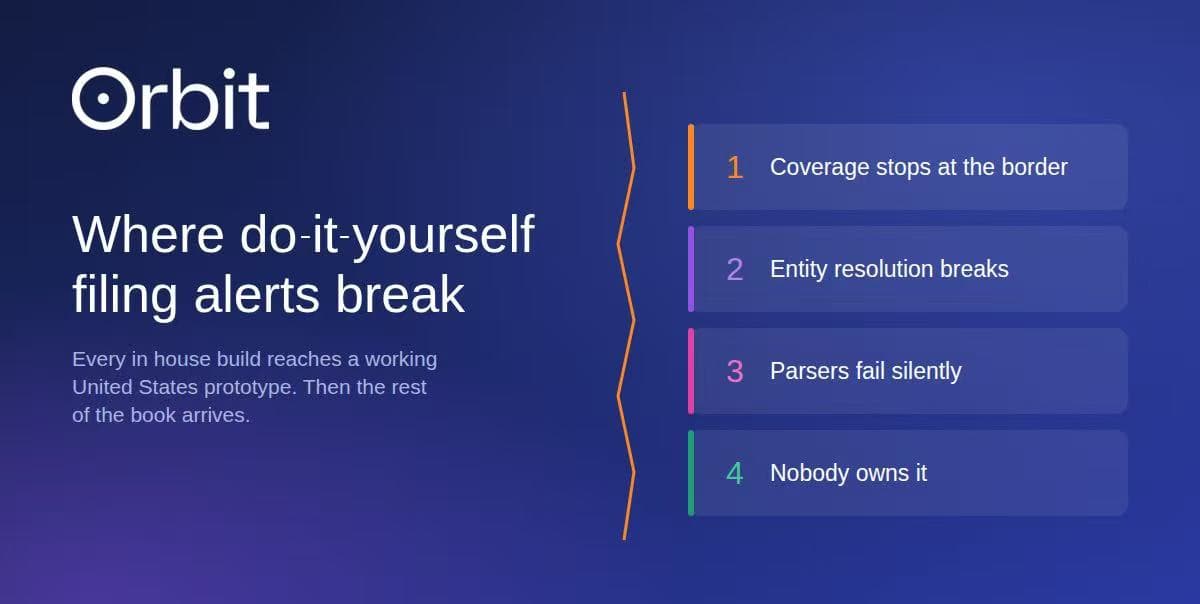
The reasoning layer is the easy part and the part specific to your process, so it is worth owning. The corpus underneath, meaning monitoring sources across jurisdictions, parsing inconsistent formats, resolving entities, and keeping it current daily, is a permanent engineering commitment rather than a project. Firms that build usually license the data anyway, at which point the question is whether the interface justified the team maintaining it.
Related blogs


thought leadership
04September2026