
6 Best Financial Data Providers With MCP Integrations in 2026
Posted 9/04/2026
4 min read

6 Best Financial Data Providers With MCP Integrations in 2026
A pattern keeps repeating in conversations with institutional research desks. The team reads a roundup, picks an MCP server, connects it to Claude or ChatGPT, and finds within a fortnight that the data underneath is too thin to support the analysis their process actually requires.
The protocol is not the problem. MCP works, and as of December 2025 it is governed by the Agentic AI Foundation under the Linux Foundation, co founded by Anthropic, Block, and OpenAI with support from Google, Microsoft, AWS, Cloudflare, and Bloomberg. More than ten thousand public MCP servers are now live. The standard is settled.
What varies enormously is what sits behind each server. How many companies are covered. Whether every figure links back to an original filing. Whether the server retrieves a number or researches a question. And whether you can use it at all without an existing seven figure data contract.
This comparison evaluates six providers on the criteria that matter when the output feeds an investment memo, a compliance report, or a portfolio decision.
Quick guide: the six best financial data providers with MCP integrations
Orbit Financial Technology. The strongest option for institutional research desks that need filing level analysis rather than data lookup, covering 50,000+ global companies with query decomposition, multi step research, and citations on every claim.
FactSet. The first major vendor to ship a production grade MCP server, exposing nine curated datasets to AI clients, available to existing subscribers within their entitlements.
LSEG. The broadest distribution of any incumbent, with MCP connectivity across ChatGPT, Gemini Enterprise, Databricks, Amazon Quick, and Model ML, rolling out in phases to licensed customers.
Kensho, part of S&P Global. An LLM ready gateway into Capital IQ financials, transcripts, and M&A data, accessible through the S&P Global Marketplace after approval.
Daloopa. A focused, audit oriented option with every data point hyperlinked to its source document, across roughly 6,000 tickers.
AlphaSense. A large document library with an Agent API, though its MCP server is published as a reference implementation you host yourself rather than a service AlphaSense operates.
How we evaluated these providers
The financial MCP ecosystem grew from a handful of community wrappers into enterprise offerings from every major vendor in under eighteen months. Choosing between them requires more than counting endpoints, because the servers look similar in documentation and behave very differently in production.
We assessed each against six criteria.
Coverage universe. How many companies, which geographies, and what happens outside United States equities. A US only feed does not serve a global mandate, and this is where most MCP servers quietly stop.
Source auditability. Can every figure be traced to the original filing and the specific page it came from? Compliance teams need to verify a claim, and a confident number with no lineage fails that test.
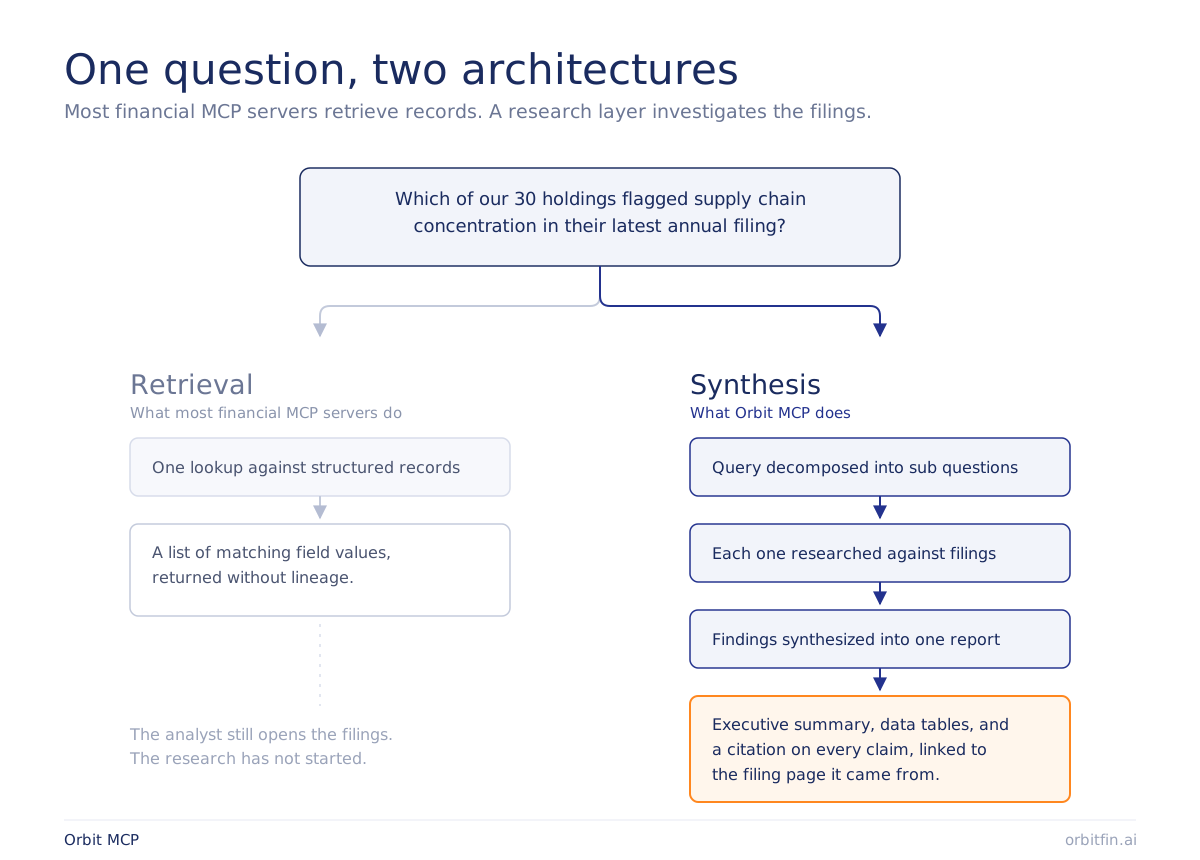
Retrieval or synthesis. Most MCP servers return data. Institutional research requires decomposing a question, researching across documents, and combining findings into something a person can act on. These are different products wearing the same protocol.
Client breadth. Does it work across Claude, ChatGPT, Copilot, Gemini, and custom agent frameworks, or does it tie you to one vendor's ecosystem?
Authentication and governance. OAuth, single sign on, audit logging, and rate limits that scale. Any tool touching investment data clears this bar or it does not get deployed.
Access model. Is the MCP available on its own terms, or gated behind an existing enterprise license and a procurement cycle? This determines whether you can evaluate it in a week or a quarter.
The six best financial data providers with MCP integrations
1. Orbit Financial Technology: best overall for institutional research
Orbit is an award winning AI investment research platform, and Orbit MCP brings its full document corpus into Claude, ChatGPT, Microsoft Copilot, and Gemini without a new interface for anyone to learn.
The difference from most servers on this list is architectural. Orbit MCP does not stop at retrieving a figure. It runs a two stage analytical workflow: the question is decomposed into three to ten focused sub questions, each researched independently against verified sources, then synthesized into a structured report with an executive summary, detailed analysis, data tables, and citations linking to the original filing pages in Orbit Insight.
Behind it sits 70 million documents processed annually across more than 50,000 global public companies, parsed at better than 99 percent accuracy with table structure preserved and entities resolved across markets. Coverage extends to 5,500 China A-Share tickers, which is the gap most global providers do not fill.
What it does well
Query decomposition means one prompt can cover financial metrics, risk factors, competitive positioning, and sustainability disclosure at once, with each strand researched separately rather than answered from a single retrieval.
Peer comparison runs up to five companies in a single query, on margins, risk factors, capital allocation, and disclosure, all sourced from filings.
Language support runs to 69 languages with automatic detection. Ask in Mandarin about A-Share companies, in German about DAX constituents, or in Japanese about Nikkei firms, and the response comes back in the query language.
Every claim carries a citation to the specific filing and page. For a compliance team, verification is one click rather than an email to the vendor.
The corpus spans official filings, earnings transcripts, curated financial news, broker research, and central bank publications, each held to the same citation standard. Every source is one an auditor can open, which is what keeps the audit trail intact as the corpus widens.
Governance covers OAuth 2.0 and API key authentication, single sign on, IP allowlisting on enterprise plans, and audit logging across every query. Python SDK support extends to Semantic Kernel and LangChain for teams building custom agent architectures.
Setup takes most teams under five minutes: add the server URL, authenticate with Orbit Insight credentials, confirm the tools are active.
Where it falls short
Real time market data is on the roadmap rather than available today, so intraday pricing and tick level data sit outside what the server returns.
Analysis runs up to five companies per query, so large universe screens require batching across requests.
Response times run from 30 to 120 seconds depending on complexity. That reflects genuine multi step research across filings rather than a cached lookup, and it is slower than a raw data call.
Standard plans carry a rolling twelve month historical window, with extended history on enterprise agreements.
Best for: research desks that need filing grounded analysis with audit trails, teams with global or APAC mandates, and firms building custom agents on top of a corpus they do not want to maintain themselves.
2. FactSet: first to production, limited to what you already license
FactSet moved earliest among the incumbents, announcing a production grade MCP server in December 2025 after a beta with more than eight hundred institutional users. It exposes nine datasets including fundamentals, estimates, ownership, M&A, pricing, people, events, and supply chain, and a portfolio analytics server followed in June 2026. It works across ChatGPT, Claude, Cursor, Databricks, Gemini, and Microsoft Copilot Studio.
What it does well
For firms already carrying FactSet entitlements, the MCP converts existing licensed content into AI accessible data with almost no engineering effort. Prompts translate into precise API calls and results return with attribution. Access is governed by existing credentials, so data governance stays consistent with the current contract.
Where it falls short
The MCP is only available to existing subscribers, and it exposes only what your specific license covers. Two firms connecting the same server can see materially different data.
The datasets are curated structured records rather than the underlying document corpus, so filing level research across risk factors or management commentary sits outside what the server does.
Sustainability data, private company financials, and benchmarks are listed on the roadmap rather than available.
Documentation is oriented around structured data retrieval, with no multi step synthesis or page level citation into source documents.
Per user pricing commonly runs from around $12,000 into the tens of thousands, so the cost of adding another person to the AI workflow is the cost of another seat.
Best for: existing FactSet clients who want estimates and portfolio analytics inside an AI assistant.
3. LSEG: the widest distribution, delivered in phases
LSEG has pursued the most aggressive distribution strategy of any incumbent under its LSEG Everywhere program. It launched an MCP server in the Databricks Marketplace in November 2025, a ChatGPT connector in December 2025, extended to Amazon Quick and Gemini Enterprise in May 2026, and to Model ML in July 2026, alongside a collaboration with Anthropic covering Claude for Financial Services.
Content spans pricing, macroeconomics, company fundamentals, estimates, forecasts, fixed income and securitized instrument analytics, and Reuters news.
What it does well
One managed connection replaces per application integration builds, and existing licensed credentials govern access without a separate API key. The semantic data model includes deterministic calculations for tasks where a probabilistic answer is unacceptable. For firms already deep in the LSEG ecosystem, the reach across AI clients is unmatched.
Where it falls short
The rollout is explicitly phased, beginning with Financial Analytics. Equity historical pricing, broader Datastream macroeconomic content, ownership data, and transcripts have been described as coming rather than available, so what you can actually query today is narrower than the announcements suggest.
Access requires existing LSEG licensing, which rules it out for firms outside that ecosystem.
The server delivers data. Multi step research, synthesis, and citation into original source documents are outside its scope.
Best for: existing LSEG customers who want licensed market data and news reaching many AI clients at once.
4. Kensho, part of S&P Global: Capital IQ through a query layer
Kensho's LLM ready API and MCP server give AI applications natural language access to S&P Capital IQ data, covering company financials, market data, business relationships, earnings call transcripts, M&A transactions, and company intelligence. It is available through a Python client for direct integration or through the MCP server for any compatible application.
What it does well
For firms already licensed with S&P Global, it removes the engineering overhead of building custom LLM integrations against Capital IQ's structured datasets. The dataset range from one endpoint is genuinely broad, and offering both a Python client and an MCP server accommodates different integration styles.
Where it falls short
Access requires approval through the S&P Global Marketplace, which inserts a procurement step before you can even evaluate it.
Documentation describes connectivity to Capital IQ data without detailing citation level source linking for individual data points, which matters when a compliance team asks where a figure came from.
It is positioned as a data query tool. Multi step research and synthesis are not what it does.
Best for: existing S&P Global clients who need Capital IQ financials and transcripts reachable from an agent.
5. Daloopa: narrow coverage, excellent lineage
Daloopa connects a financial database of more than 6,000 global tickers to AI tools through a read only remote MCP server secured with OAuth. The distinguishing feature is granularity: the company collects substantially more data points per company than typical providers, including guidance, non GAAP KPIs, and operational metrics, with every figure hyperlinked to the filing, press release, investor presentation, or transcript it came from. Reported accuracy exceeds 99 percent. Document access and keyword search tools were added during 2026.
What it does well
Source lineage is genuinely strong and the audit workflow it supports is real. Coverage of guidance and operational KPIs goes beyond standard financial statement line items, which matters for modeling. The remote server requires no local infrastructure, and it works across Claude, ChatGPT, Microsoft 365 Copilot, and Perplexity.
Where it falls short
Coverage of roughly 6,000 tickers is the binding constraint. Smaller capitalization names, emerging markets, and most of Asia sit outside it, so a global mandate will hit the edge of the universe quickly.
The document tools cover United States SEC filings, press releases, and investor presentations, with transcript search limited to United States coverage. Multi language support is not documented.
The focus is structured fundamental data. Filing level research, cross company synthesis, and qualitative analysis across a coverage universe are outside its scope.
Best for: modeling and earnings work on large capitalization United States names where source lineage is the priority.
6. AlphaSense: a large library, a sample server
AlphaSense operates one of the largest document libraries in the category, exceeding 500 million documents, much of it licensed content alongside the expert call inventory acquired with Tegus. In 2026 it introduced an Agent API with MCP tooling, and its Enterprise Intelligence product supports deployment into AWS and GCP.
What it does well
Search quality across Western filings, transcripts, and broker research is strong, and the expert call library has no direct equivalent elsewhere on this list. Internal content can be indexed alongside external material.
Where it falls short
The MCP position is weaker than the announcement volume suggests. AlphaSense's own developer documentation describes its MCP server as a locally hosted reference implementation, meaning your team runs and maintains it rather than connecting to a service AlphaSense operates. That is a materially different commitment from a hosted endpoint, and it lands on your infrastructure team.
Pricing is quote only with no published list and no self serve tier. Reported enterprise seats cluster near $18,000 a year before content add ons that buyers commonly describe as another twenty to forty percent of contract value, and seats are sold in bands, so adding a small number of users can move a firm into a higher tier.
Coverage outside developed markets is thinner than the headline document count implies, and the platform is prescriptive for teams wanting agents built to their own logic.
Best for: existing AlphaSense clients whose priority is expert call content and who have engineering capacity to host the server.
Also worth knowing
Bloomberg has taken the opposite path deliberately. It runs Enterprise MCP infrastructure internally, contributed the Variants extension to the specification, and holds seats on both the board and the Technical Committee of the Agentic AI Foundation. In January 2026 it launched ASKB, an agentic layer inside the Terminal. What it has not done is expose an external MCP connector into Claude, ChatGPT, Gemini Enterprise, or Copilot Studio.
The reasoning is straightforward once stated. Every vendor that ships an external connector makes its data queryable and comparable against every competitor that has also connected, and gives up ownership of the interface through which its data is accessed. Bloomberg has spent decades making that interface indispensable and has chosen not to concede it. For a buyer, the consequence is simple: Terminal data does not reach your AI workflows through an open protocol, and the community built wrappers that attempt it require a logged in Terminal running on the same machine.
Open source servers exist and have real limits. Community maintained options such as Financial Datasets provide free access to United States equity prices, SEC filings, and financial statements, and they are a reasonable starting point for a prototype. They return raw data with no entity resolution, no synthesis, and no international coverage, and reliability depends on contributor activity rather than a service agreement. For anything feeding a compliance report or an investment decision, that is not a foundation.
Comparison at a glance
Coverage universe. Orbit covers more than 50,000 global public companies including 5,500 China A-Share tickers. Daloopa covers roughly 6,000 tickers with a United States weighting. FactSet, LSEG, S&P Global, and AlphaSense all vary by license, so the number depends on your contract rather than the vendor.
Citation to source filings. Orbit links every claim to the specific filing and page. Daloopa hyperlinks every data point to its source document. FactSet, LSEG, and Kensho return attributed data without documented page level linking into original filings.
Retrieval or synthesis. Orbit decomposes questions and synthesizes multi step research across filings, transcripts, news, broker research, and central bank publications into a structured report. Every other provider on this list is built to retrieve.
Hosted or self hosted. Orbit, FactSet, LSEG, Kensho, and Daloopa all operate hosted servers. AlphaSense publishes a reference implementation you host yourself.
Multi language. Orbit supports 69 languages with automatic detection. No other provider on this list documents comparable multi language querying.
Access model. Orbit publishes its pricing and includes MCP access at every tier. FactSet, LSEG, Kensho, and AlphaSense all require an existing enterprise license, and Kensho adds a marketplace approval step before evaluation.
Client support. All six work with Claude and ChatGPT. Orbit, FactSet, LSEG, and Daloopa extend to Copilot and Gemini.
What makes MCP different from a traditional financial data API
A traditional API requires you to know which endpoint to call, what parameters to pass, and how to interpret the response schema. The analyst writes the question, an engineer builds the integration, and the two rarely work in the same tool.
MCP removes that translation layer. The analyst asks in natural language inside Claude, ChatGPT, or Copilot, and the server handles routing, calls, and formatting. Since the protocol moved to Linux Foundation governance in December 2025, the standard is stable enough for institutional teams to build against without vendor risk.
The practical gain is speed to insight, and it changes who can ask. When financial data becomes reachable from the tool an analyst already has open, the question no longer has to be important enough to justify an engineering ticket.
How institutional teams should evaluate MCP providers
Start with the data underneath, not the interface. An MCP server is only as good as the corpus it exposes. If that corpus lacks entity resolution across markets, table structure preservation, or multi language coverage, your AI outputs inherit every one of those gaps and present them confidently.
Three questions cut through vendor positioning quickly.
Can every claim be traced to a source filing? If the server returns figures without page level citation, your compliance desk cannot verify the output, and the work has to be redone by hand before it can be used. Ask for a specific example, not a policy statement.
Does it synthesize or only retrieve? Retrieval is useful and it is the easy half. Institutional research means decomposing a question, researching across documents, and combining findings into a structured answer. Most servers available today stop at retrieval, and the difference only becomes visible once your team is using it.
What happens when you scale beyond one analyst? A single query is a demo. Running batch analysis across a coverage universe, or supporting fifty agents built by different desks, requires enterprise authentication, rate limits that scale with the subscription, and audit trails across every call. Ask what the rate limit actually is.
One more, and it is the one buyers ask last and regret: can you evaluate it without an existing license? Four of the six providers here require an enterprise contract before you can test the MCP at all.
Why Orbit is the strongest option for institutional research
The pattern across this category is now clear. Most providers took an existing data feed and wrapped it in an MCP endpoint. That gives AI tools access to structured records, which is useful and which is also a data pipe.
Orbit built its MCP as a research layer. Ask a question and it decomposes the query into sub questions, researches each against verified filings across more than 50,000 companies, and synthesizes the findings into a structured report with citations linking to original documents. The corpus underneath processes 70 million documents a year at better than 99 percent parsing accuracy, spans 69 languages, and includes the China A-Share coverage that most global providers leave out.
For a research desk, that distinction decides how the tool gets used. Analysts need answers grounded in filings they can verify, rather than raw data they then have to interpret before it becomes an answer.
Orbit is also the only provider here that publishes its pricing and includes MCP access at every tier, so evaluation does not require a procurement cycle.
These are conversations that matter deeply to us at Orbit. If your desk is building AI research workflows and needs a data substrate you can audit, talk to our team about deploying Orbit MCP across your firm.
Frequently asked questions
What is the Model Context Protocol for financial data?
MCP is an open standard connecting AI applications such as Claude, ChatGPT, and Copilot to external data sources. For financial data it lets an AI assistant query filings, market data, and transcripts directly rather than relying on training data. Anthropic donated the protocol to the Agentic AI Foundation under the Linux Foundation in December 2025, and more than ten thousand public MCP servers are now live. Orbit MCP goes beyond retrieval by decomposing questions into multi step filing research with citations on every claim.
Which financial data MCP providers support multi language research?
Orbit supports queries and responses in 69 languages with automatic language detection, covering A-Share companies in Mandarin, DAX constituents in German, and Nikkei firms in Japanese. No other major financial MCP provider documents comparable multi language querying, and most describe English only support.
Can an MCP server replace a financial data terminal?
It depends on the job. For filing level research, document analysis, and synthesis across a coverage universe, Orbit MCP covers more than 50,000 companies with cited multi step research and is a genuine alternative to terminal based workflows. For real time trading execution, tick level market data, and market messaging, a Terminal remains the right tool, and Bloomberg has deliberately kept that capability inside its own interface rather than exposing it through MCP.
How do I connect a financial data MCP server to Claude or ChatGPT?
Setup varies by provider. For Orbit, add the server URL to your AI client, authenticate with your Orbit Insight credentials, and confirm the tools are active. Most desks are live in under five minutes. Providers that require an existing enterprise license will also need entitlement checks, which typically adds days rather than minutes.
Is financial data accessed through MCP secure enough for institutional use?
That depends entirely on the provider's governance model rather than on the protocol. Orbit uses OAuth 2.0 and API key authentication with single sign on support, IP allowlisting on enterprise plans, and audit trails across every query. When evaluating any provider, confirm whether the server is hosted by the vendor or self hosted, since a reference implementation you run yourself puts operational and security responsibility on your own team.
Which providers offer hosted MCP servers rather than code samples?
Orbit, FactSet, LSEG, Kensho, and Daloopa all operate hosted servers. AlphaSense publishes a reference implementation intended for local hosting. Bloomberg operates Enterprise MCP infrastructure internally without an external connector to third party AI clients. The distinction matters because a self hosted sample transfers maintenance, uptime, and security responsibility to you.
Do I need an existing data contract to use a financial MCP server?
For FactSet, LSEG, Kensho, and AlphaSense, yes. Access is governed by existing entitlements, and Kensho adds an approval step through the S&P Global Marketplace before evaluation. Orbit publishes pricing from £75 a month with MCP access included at every tier, so a desk can test it without a procurement cycle.
What coverage should a global mandate expect from an MCP provider?
Ask specifically about what happens outside United States and Western European equities, because that is where most coverage claims stop. China A-Share disclosure is the clearest test, since mainland listed companies publish material with no Western equivalent, including mandatory disclosure of institutional on site research meetings. Orbit covers 5,500 A-Share tickers. Most providers on this list cover the region partially or through licensed third parties.