
Screen the market. Screen your book.
One agent, pointed either way. Search outward across 75,000 companies for names you have never held, or turn the same screen inward on a portfolio you already own. Both read what companies file, say, and publish, and both come back with the evidence behind every name.
What it is for
One agent, pointed two directions.
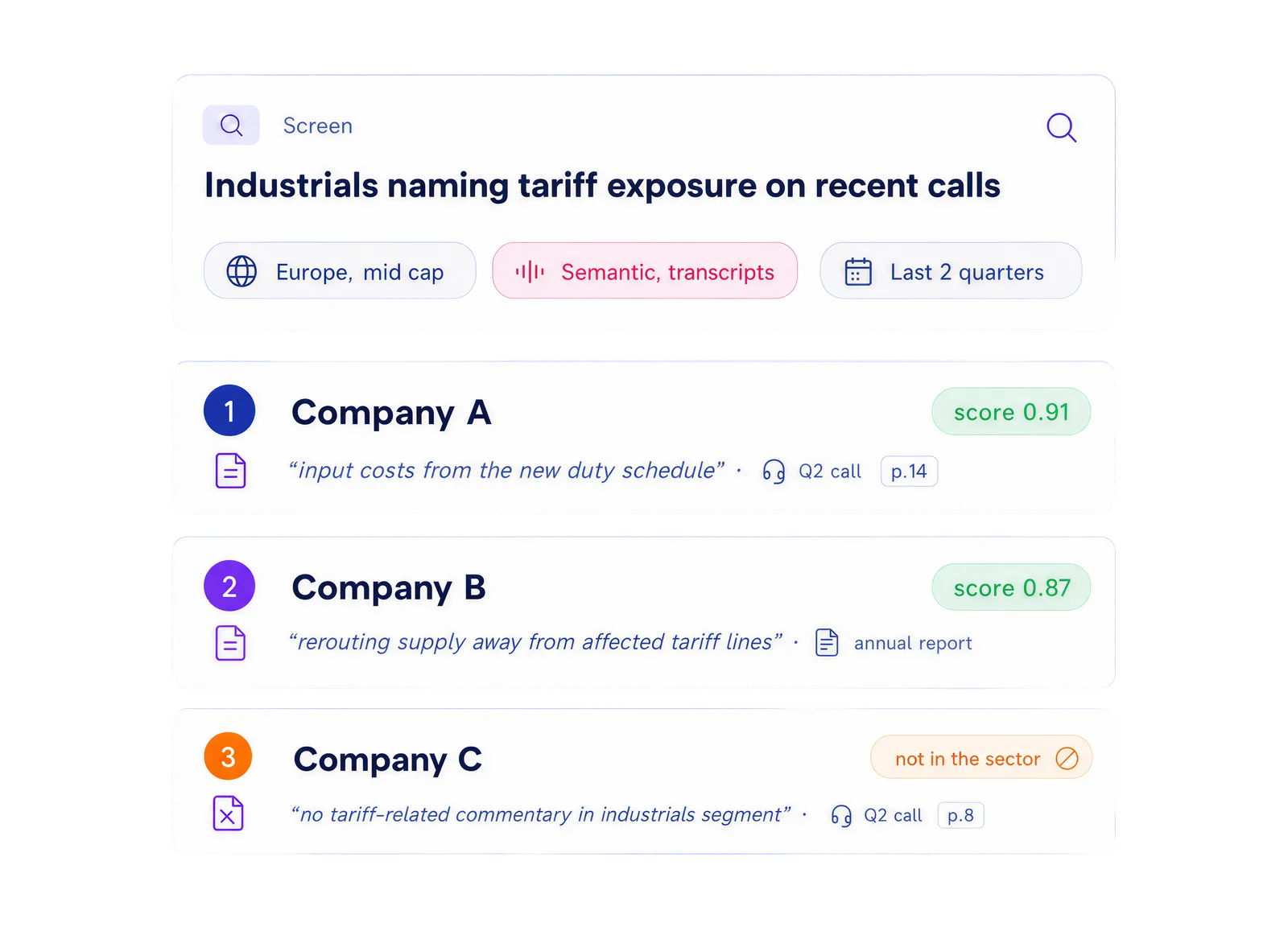
One agent does both, at the same depth. It reads the full document record behind every company, ranks what it finds, and shows you the passage behind every match, whether it is working across seventy five thousand companies or the forty you hold.
Screen the market
Point it outward at the world. Set a universe by country and market cap, describe what you are looking for, and find the companies that match your thesis without carrying the sector label, the index membership, or the exact keyword you would have thought to search for. This is where the names you have never held come from.
Screen your book
Point it inward at what you already hold. Run the same screen across a portfolio, a watchlist, or a coverage list to surface exposure, language, and performance criteria across every name at once. Run it on demand, or set it to run and report only what changed.
How it works
From a thesis to a candidate list.
Screening comes configured and ready to run. There is no agent to build and no setup project to sit through first.
Point it
Outward at the market, using country and market cap or an index. Or inward at a portfolio, watchlist, or coverage list you already hold.
Describe what you want
State the thesis as a concept, with its aliases and exclusions, and choose which techniques run it.
Review the candidates
Get a ranked list with a score, a hit count, and every claim clickable through to the page it came from.
Chain it or schedule it
Save the result as a portfolio and screen it again, or set it to refresh as new documents land.
What it does
Screening built on what companies actually say.
Orbit has already read the documents, so a screen can work on strategy, management commentary, and disclosed activity alongside the numbers.

Qualitative and quantitative together
Screen on themes, language, and disclosed strategy alongside numeric criteria and your own uploaded fields, in a single run rather than two separate exercises.

Coverage of all public equities
Screen the full listed universe, 75,000 companies across 120 countries and 80+ exchanges, including the markets most platforms cover thinly.

Evidence on every match
Each name returns with a score, a hit count, and the passage that supports it, cited to the page it came from. If the reason a company is on the list cannot be shown, it is not on the list.

Screens that chain
Save any result as a portfolio and feed it into the next screen. Build a sequence as long as your process needs, and branch it where that helps.
How you screen
Five techniques. You choose what the question deserves.
No single method reads a market well on its own. A precise phrase and an open ended thesis are different questions, so Orbit gives you all five and combines them in one run.
| Technique | What it does | Where it is strong, and where it is not |
|---|---|---|
| Keyword on filings | Exact matching over the official record, returning hits per document, a mention trend over time, and every source. | Fast and light. Literal, so it misses paraphrase. |
| Keyword on news | The same concepts matched against news flow, per company and date range, with every hit linked to its article. | The freshest signal. Noisy, so treat it as a trigger. |
| Semantic search | Finds documents about an idea whatever the wording. Reducing share count surfaces buyback discussion that never uses the word. | Best reach. Relevant is not the same as verified. |
| AI reading | Reads the documents themselves, confirms the event actually happened, and extracts the amounts, dates, and percentages, each cited to its page. | Highest precision. Slow and costly, so it runs on a shortlist. |
| Structured filters | Classic numeric screening on market cap, returns, and derived values, alongside your own uploaded data. | Instant and exact. Sees only what is in the columns. |
Structured filters accept your own spreadsheet. Upload a file keyed on ISIN and name, and its columns become screenable fields sitting next to Orbit's, so an internal rating or a house metric can be part of the same screen.
A worked example
Narrow first. Verify last.
A screen is a pipeline. Take capacity expansion across Asia. Structured filters cut 75,000 companies to the Asian names above two billion dollars in market cap. Keyword matching on the concept, carrying seventeen aliases across four languages, finds the companies discussing it. Semantic search widens the net to companies describing it without using those words, and ranks what comes back. Then AI reading verifies each survivor and pulls the amounts, dates, and funding.
The order is the point. Reading every company in the starting universe would cost many times what the pipeline costs, and the answer would be no better. You see the plan, stage by stage, before anything runs.
Pointed inward the sequence collapses, because a portfolio is small enough to send straight to AI reading. Same concept, same evidence, forty holdings instead of seventy five thousand companies.
See the use case library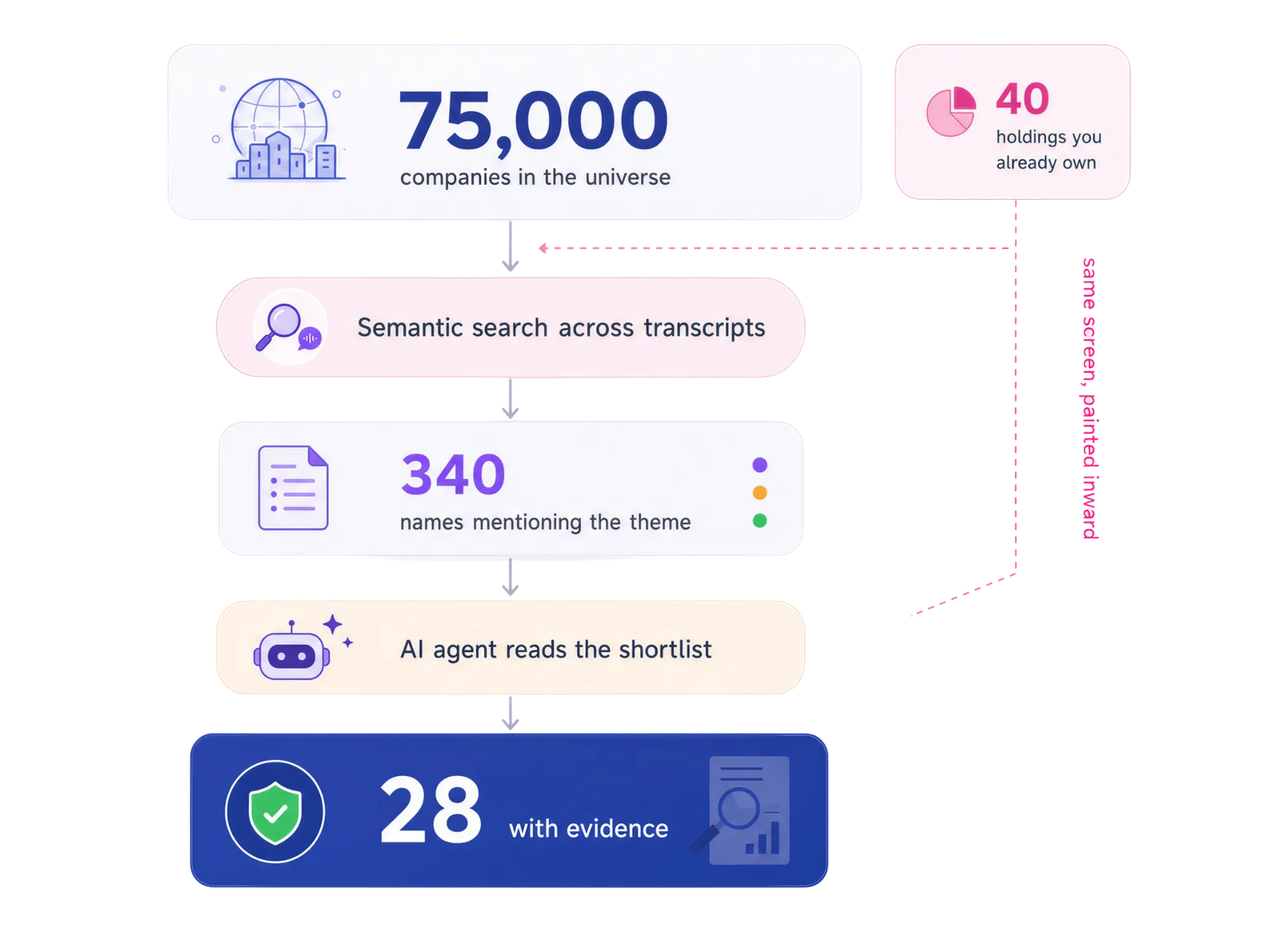
Who it is for
Anyone who starts by narrowing a universe.
Active teams use it to reach names they have never held. Teams with a fixed and well known universe use it the other way, applying criteria across the companies they already follow.
Active fundamental teams
Analysts and portfolio managers covering more names than there are hours, who need the shortlist to be defensible as well as short.
Systematic and quant teams
Teams sourcing candidate lists and features from text, who want the screen reproducible and the output structured.
Sustainability and stewardship
Teams screening for controversies, disclosure quality, and policy alignment, where the evidence trail matters as much as the result.
Where it fits
It works alongside what you already run.
Screening does not ask you to remove a terminal or replace a research platform. It answers the question those systems were never built to answer, which is finding companies by what they say and do rather than by how they have been classified, in the market and in the book you already hold.
Orbit reads the document layer that sits underneath your existing structured data, so the screen extends what you already pay for instead of competing with it.
See the platform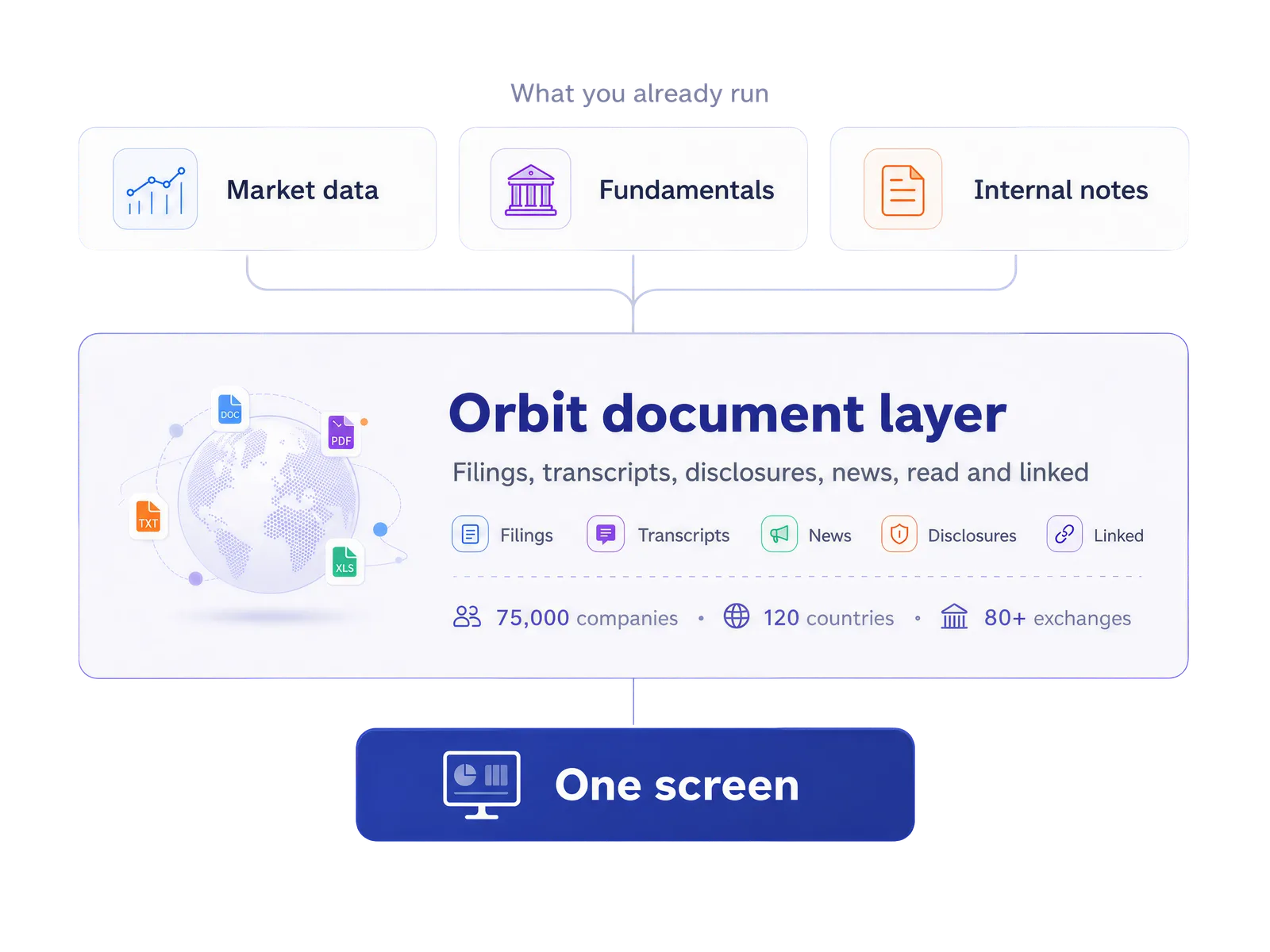
What makes it yours
Your vocabulary, defined once and reused everywhere.
The settings underneath a screen are where a generic tool becomes your process.

Concepts
A concept holds a name, a plain language description that also drives the semantic search, aliases in every language you cover, and exclusion terms that kill the false positives you already know about. Define it once and every screen and monitor uses it the same way. Orbit ships translated concept packs for major themes, ready to clone and adapt.

Scoring you control
Each technique contributes its own sub score, with a weight you set. A company missing one kind of evidence is re weighted rather than penalized for the gap.

A confirmed no wins
Where AI reading establishes that a company did not do the thing, it comes off the list whatever it scored elsewhere, and it is shown to you rather than quietly dropped.

Screens become monitors
Any saved screen re runs on a schedule, reading only the documents that have arrived since, and reports who entered, who left, and what changed.
Common questions
Questions investment teams ask us.
How is this different from a stock screener?
A conventional screener filters on fields in a database, such as market cap, sector, or a valuation multiple. Orbit screens on what companies disclose in their documents, so you can look for a strategy, an exposure, or a change in commentary that no database field records.
Can I screen on something that is not a database field?
Yes. Describe the criteria in plain language. Semantic and AI methods find companies matching the concept even where the wording differs from yours and the company sits outside the obvious sector.
How do I know the screen did not miss a company?
Screens run across the full universe you set rather than a sampled subset, and every result carries a score and a hit count. You can see which names ranked just below the cut and why, which is where most missed candidates would otherwise hide.
How do I know what a screen will cost before I run it?
Every run is previewed. Before anything starts you see the plan stage by stage, with the company count entering and leaving each stage and what that stage will take. The early stages are near instant, and because AI reading only ever runs on the survivors of those stages, the most thorough work stays proportionate to the question.
Can I screen using my own data alongside Orbit's?
Yes. Upload a spreadsheet keyed on ISIN and company name and its columns become screenable fields next to Orbit's own, so an internal rating, a house metric, or an analyst flag can be a criterion in the same screen.
Does it handle companies that disclose in other languages?
Yes. A concept carries its aliases in every language you cover, so one screen matches the same idea across markets whatever the local wording. Orbit ships translated concept packs for major themes.
Can I screen my own portfolio or watchlist?
Yes, and it is one of the two things the agent is built for. Point the same screen at a portfolio, a watchlist, or a coverage list to find exposure, language, or performance criteria across every holding at once. Any screen result can also be saved as a portfolio and used as the input to the next one.
Is screening the market a different product from screening my portfolio?
No. It is one agent pointed two ways, with the same depth of document reading behind both. You set the criteria that suit the question you are asking, and the agent handles a global universe or a single portfolio without changing tools.
Does it replace my existing data provider?
No. Screening reads the document layer beneath the structured data you already license, and it is designed to run alongside your existing tools rather than in place of them.
How current are the results?
Documents are processed and available for screening ahead of the next market open, so a screen run in the morning reflects what was filed and said the day before.
Which markets are covered?
75,000 companies across 120 countries and 80+ exchanges, including deep coverage of markets that are commonly thin elsewhere, with more than ten years of history behind the screen.
Screen the market. Then screen your book.
Bring a thesis and your holdings list. We will run both directions in the award-winning Orbit Insight platform, on your names, in a single session, and show you the evidence behind every match.