
Build your research process once. Run it everywhere, forever.
Every investment team has a way of working that lives in analysts' heads and spreadsheet templates. Orbit Agent Builder lets you capture it, in plain language or a few visual blocks, and run it across your entire universe, on a schedule, without writing a line of code.
From idea to deployed agent
Four steps, no code.
Describe it
Say what you want in plain language, or upload your existing methodology document.
Connect data
Knowledge Base, your internal documents, and live sources, all linked through the entity master.
Set coverage
Choose the universe, the schedule, and what counts as worth flagging.
Deploy
It runs on its own and is exposed as an MCP endpoint, available in Claude, ChatGPT, and your own tools.
The Automate mode
Your logic, captured and run at a scale no person could manage.
Agents in Orbit are not a fixed catalogue handed down and frozen. They are something your team creates, shapes, and owns. An agent encodes your logic, the metrics you always check, the questions you always ask of a new filing, the way you judge whether something matters, and runs it across the connected data continuously. The data underneath is common to the whole firm. The agents on top are each user's own.
Build without engineering
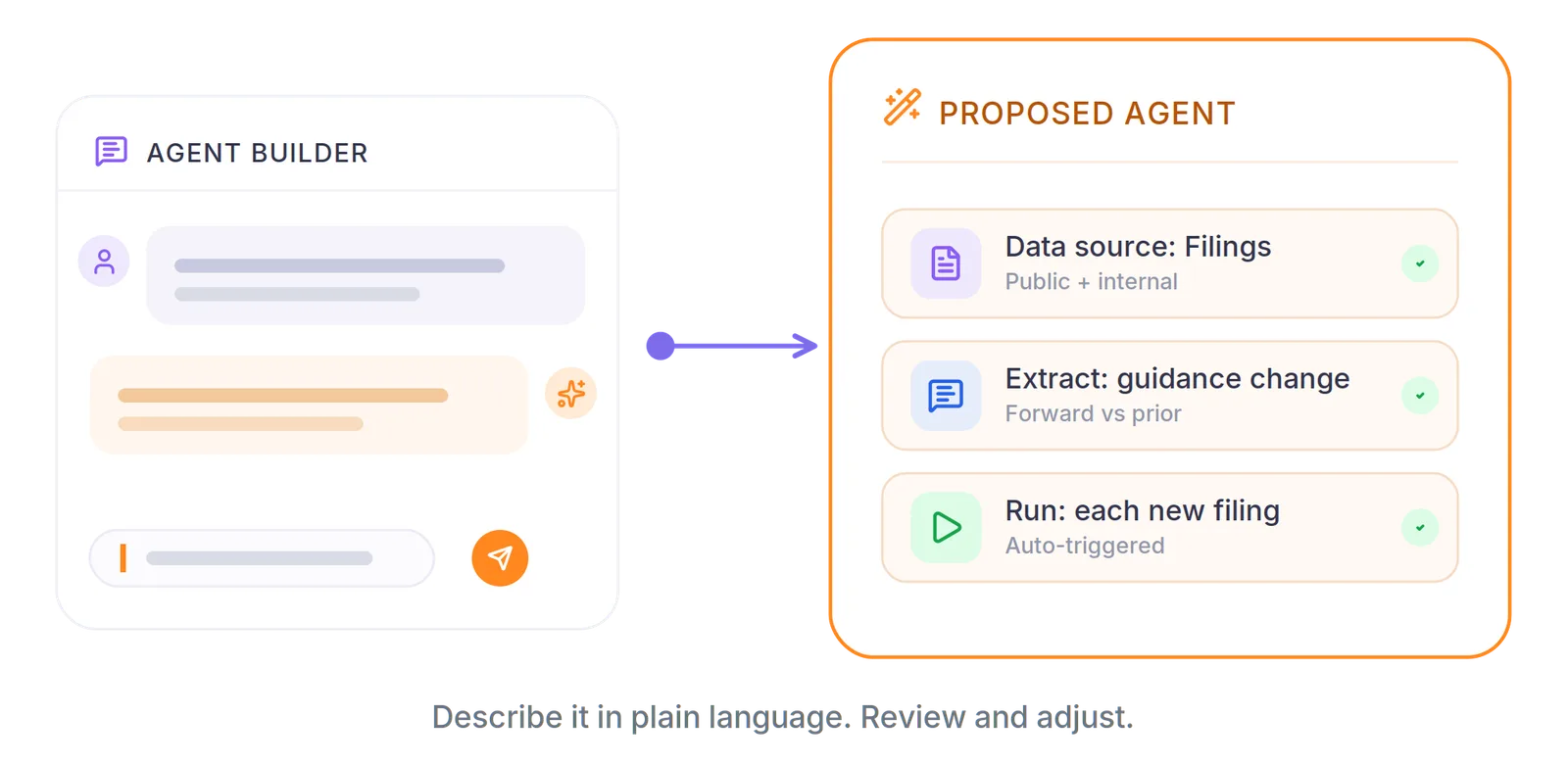
The Agent Builder is a visual environment. Assemble an agent from building blocks, connect them, and watch how it behaves, the way you might sketch a process on a whiteboard, except the process then runs. For many needs you can simply describe what you want in plain language and have Orbit propose an agent to match, which you review and adjust.
The people who know the research, analysts, PMs, sector specialists, build the agents. No briefing an engineering team and waiting.
From building blocks to end-to-end workflows
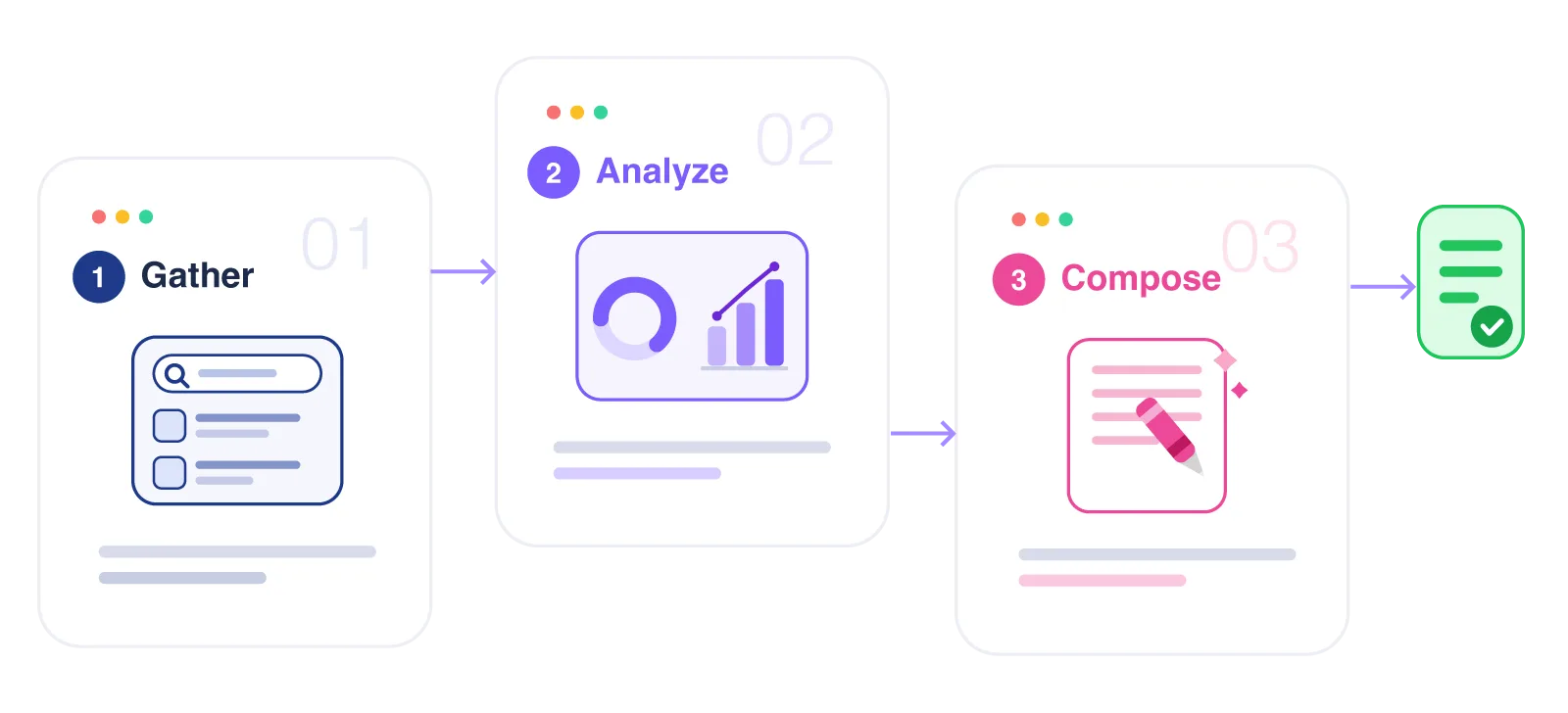
The smallest blocks do focused jobs: pull a figure, detect a change, format an output. These combine into larger agents that carry out a complete task, and those link together so the output of one becomes the input to the next. Chained this way, a series of agents carries a piece of research from end to end, gathering inputs, doing the analysis, producing the output, on a schedule or a trigger.
Start with a single small agent and grow toward an automated process that runs a meaningful part of your research with no manual steps.
Build your logic, not your infrastructure
Spend your time on your edge, not on plumbing.
Building an agent means building your logic, your view of what matters and how to assess it. It does not mean building the infrastructure underneath: the connected data, the entity master, the structured and document layers, the orchestration, the choice of models. All of that is already there, maintained for you.
You build
Your methodology, your metrics, your thresholds, your definition of what matters and when to act.
You own
Each user maintains their own agents and refines them as their thinking evolves, a growing asset that captures their method.
Orbit provides
The connected data, the entity master, the structured and document layers, the orchestration across models.
Orbit maintains
Keeping the backbone current as companies change and new documents arrive, so you never have to.
A firm's edge is in its judgment and its process. The data infrastructure beneath it is not where a firm should spend its time. It is what Orbit provides so the firm can spend its time on the part that is actually its own.
Capture what walks out the door
Your team's methods, preserved and run consistently.
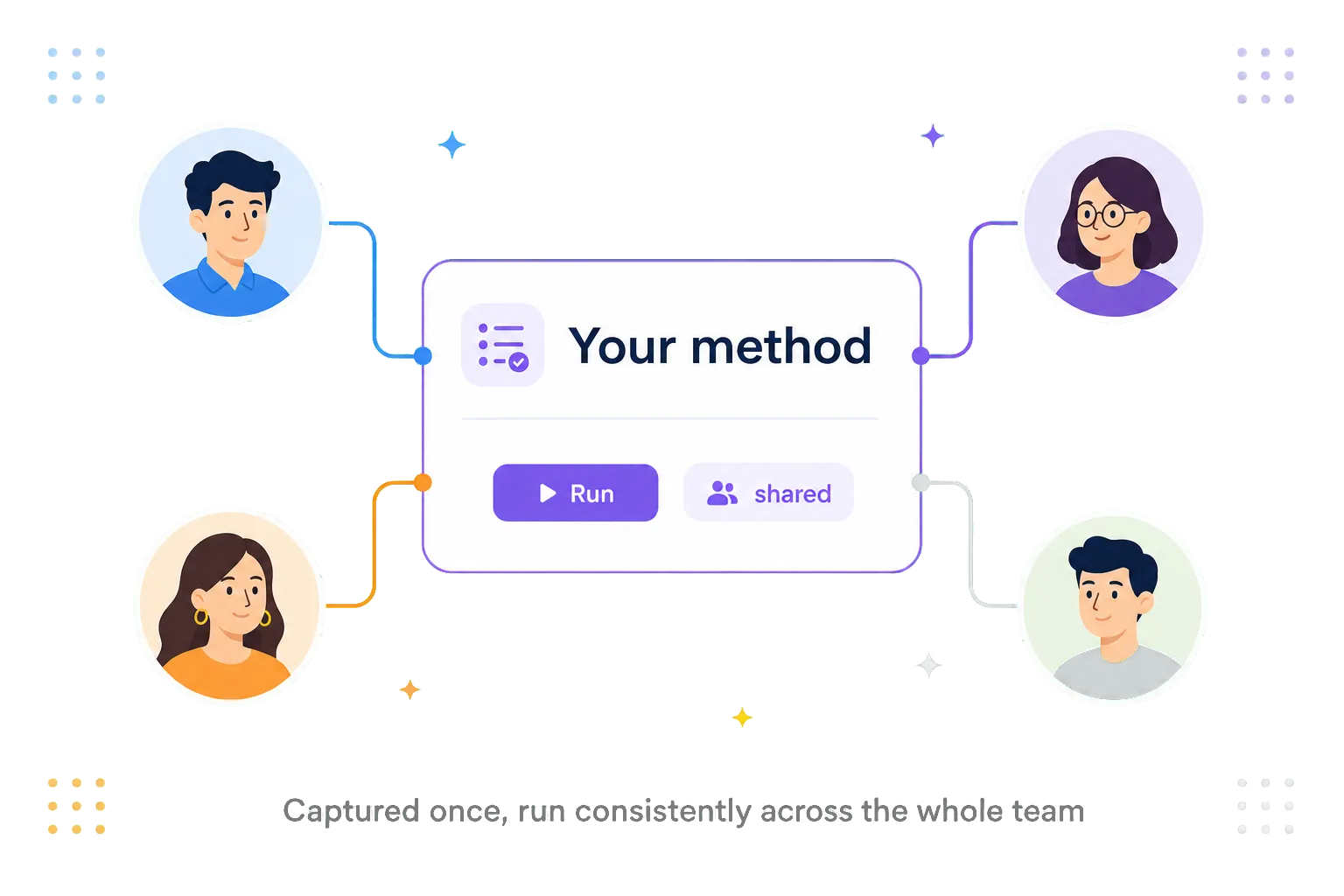
Methods that once lived only in individual analysts' heads become things that can be captured, shared, and run consistently across the whole coverage universe. The way your firm does research can be encoded, applied at scale, and preserved even as people come and go.
Off-the-shelf, or built by you
Begin with ready-made agents. Make them yours.
A team gets value on day one, without building anything. Orbit ships off-the-shelf agents for the most common research work, each drawing on the connected data and returning results with sources attached. They are useful immediately, and they are the natural bridge to building your own.
Filings Insight Extractor
Reads a company's filings and disclosures and pulls out what matters, the figures, changes, guidance, and risks, so an analyst starts from the substance rather than page one.
Portfolio News Tracker
Keeps a portfolio or coverage list under continuous watch, surfacing the news that bears on held names and filtering out the noise.
Summary Composer
Turns underlying data and documents into a written briefing, overview, or digest, composed from the connected data and carrying its sources.
Data Transformer
Renders data and documents into the structured form a team needs, ready for analysis, for a model, or for another agent further down a workflow.
Stop briefing engineers. Start building agents.
See how investment teams build their own research agents in plain language and run them across their entire universe. These are conversations that matter deeply to us at Orbit.